
Table of Contents
ToggleWhat is High Volume PCB Assembly?
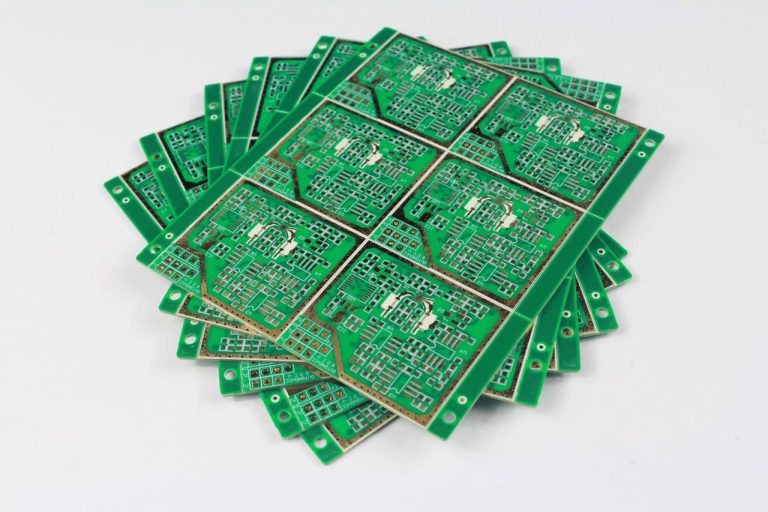
High-volume PCB Assembly also called Large Volume PCB Assembly, is when a manufacturer assembles printed circuit boards in large quantities, totaling more than 1,000 printed circuit board circuits per production cycle. For high-volume printed circuit boards, mass production is the main goal. Productivity can be increased by using automated high-volume PCB assembly technology. It is a non-toxic, environmentally friendly method. The circuits are built efficiently, reliably, and uniformly.
The Importance of High-Volume PCB Assembly
Economies of Scale
Consistency and Quality
Fulfilling Market Demand
Short Production Cycle
One-Time Prototyping and Design Process
The High-Volume PCB Assembly Procedures
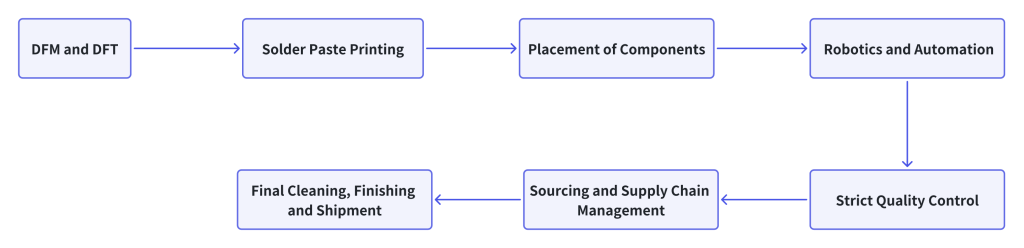
Step 1: The Design for Manufacturability and Testability (DFM and DFT)
- Optimization: Placement, trace routing, and layer stack-up are kept in mind while designing the PCB for mass production.
- Error Elimination: By addressing manufacturing challenges early in the design phase, errors, and therefore rework, can be minimized.
Step 2: Solder Paste Printing
- Stencil printing offers accuracy and faster application. However, it takes time to produce stencils, which reduces turnaround time. Therefore, many manufacturers prefer jet printing for high-volume PCB manufacturing.
- Jet printing offers more flexibility, allowing manufacturers to assemble different board designs without a different stencil each time.
Solder paste is applied and then passed through the placement machine. Since computers control their movement, all ensure greater accuracy, speed up the process, and reduce human error. These machines play an important role in ensuring the success of the high-volume assembly process.
Step 3: Placement of Components
Step 4: Robotics and Automation
- Surface Mount Technology (SMT): Parts of a PCB are precisely positioned on its surface.
- Pick-and-Place Machines: These machines place components on PCBs quickly and consistently.
- Reflow Soldering: In which the solder is melted and bonded onto the PCB.
Step 5: Strict Quality Control
- Automated Optical Inspection (AOI): In this technology, with the help of cameras, PCBs are inspected automatically for defects.
- In-Circuit Testing (ICT): This is the name of electrical testing to ensure that the board works properly.
- Functional Testing: Verifies that the PCB will work as intended in a real-life condition.
Step 6: Sourcing and Supply Chain Management
- Component Sourcing: Finding trustable suppliers from where you will get the parts at a constant rate.
- Inventory Control: The demand and supply are balanced, eliminating shortages or surpluses, thus providing a mechanism for effective inventory control.
Step 7: Final Cleaning, Finishing and Shipment
Now that the printed circuit board has been tested and is clean in all respects, it is time to clean it of unwanted residual flux, finger dirt, and grease. A stainless steel pressure washing tool using deionized water is sufficient to clean all types of dirt. Deionized water will not damage PCB circuits. After cleaning, the PCB is blown dry with compressed air.
The final PCB is now ready to be packaged and shipped. Assembles printed circuit boards into their final form, including exteriors and enclosures. To ensure that what they produce is packed safely enough to reach from the side of them, deliveries, and transportation.
High Volume PCB Assembly Considerations
When you do mass production PCB assembly, you must take care of the following things.
Design for Manufacturability (DFM)
Design for Testability (DFT)
First Article Inspection (FAI)
Supplier Selection
Professional Manufacturing Skills
Economies of Scale
Strategic Partnerships
Innovative Technologies in High-Volume PCB Assembly
Advanced Automation
- Robotics and AI: While these have been employed in assembly operations for some time, their application is becoming more widespread as manufacturers look to increase accuracy, speed, and flexibility.
- Machine Learning: Leveraging machine learning algorithms to predict and prevent any future issues in the production.
Connect with Open-Source Industry 4.0 and Internet of Things (IoT) Integration
High Density Interconnect Technology (HDI)
Eco-Friendly Production Techniques
High-Volume PCB Assembly challenges
Optimizing Manufacturing Procedures
Consistency and Quality Preservation
Cost-Effective Strategies
Purchasing Components
Preserving Flexibility
Ease of Transition from Prototyping to High-Volume Production
Retaining Traceability and Compliance
Technological Complexity
Partnering with FC helps you succeed
Prior PCB Assembly
Turnkey Solutions
FC can offer turnkey service involving everything from sourcing parts, making circuit boards, and finally completing the assembling process and testing.

Collaborative Approach
FC by providing technical advice, design proposals, and preemptive problem-solving, producers of high-volume PCB assemblies work hand in hand with their clients to ensure that the final product exceeds or meets expectations.

Responsive Support
Customers’ queries can easily be answered by FC, which is due to dedicated customer service staff.

Dedication to Continuous Improvement
Conclusion
Large-scale PCB assembly is vital for producing large qualities of electronic devices quality-wise. Mass-scale electronics manufacturing is anything but straightforward, and that’s exactly what high-volume PCB assembly streamlines with a complex, optimized process. Using state-of-the-art technology and optimizing processes results in more high-quality printed circuit boards. In addition, at the same time, it ensures that they remain competitive and profitable. Businesses that follow this advice can stay abreast of the developments in the electronics ecosystem while enabling everything to continue working.