Table of Contents
TogglePrinted circuit boards (PCBs) are the backbone of modern electronics, but their performance hinges on the materials chosen for each layer. From the substrate that forms the foundation to the silk screen that adds clarity, every layer has unique material requirements. In this blog, we’ll break down the materials used in each PCB layer, their properties, and how to select the right ones for your project.
What are PCB Materials?
PCB materials are the integral blocks that define the structure and functionality of a PCB. Key components include:
- Substrate: Mechanical support and electrical insulation.
- Copper Layers: Conduction path carrying electrical signals.
- Silkscreen: Labeling of components used during assembly and in aiding in troubleshooting.
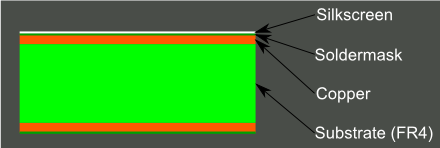
All these materials are selected to give properties such as heat resistance, flexibility, and cost efficiency that are necessary for their application in PCB design.

PCB Material Types
Majorly, the following four categories define the types of PCB materials: substrate materials, conductive materials, dielectric materials, and solder mask materials. Now, let's dive deep into the basic types of PCB materials below.
PCB Substrate Materials
- Description: FR4 is the most commonly used PCB material, a composite material made from woven fiberglass cloth reinforcement impregnated with flame-retardant epoxy resin.
-
Properties:
-
Good Mechanical Strength & Thermal Stability
-
Flame Retardant (UL94 V-0 rated)
-
Dielectric Constant (~ 4.5)
-
Cheap & Robust
-

- Applications: Widely used in consumer electronics, automotive, and telecommunication applications.
Polyimide
- Description: Flexible substrate keeps performance up to the flex point in temperature.
-
Properties:
-
Flexibility & Thermal Stability (up to 200℃)
-
Low Dielectric Constant & Loss
-
Chemical Resistance
-
Mechanical Toughness
-

- Applications: Applications requiring high flexibility like flexible PCBs, automotive, aerospace, and medical devices that have specifications for such extreme conditions.
- Description: Core made from aluminum or copper to conduct heat laterally out of the metal layers for higher thermal performance and achieve heat dissipation.
-
Properties:
-
High Thermal Conductivity
-
Improved Mechanical Strength
-

- Applications: Used mostly in LED lighting and power electronics as in power conversion and motor drives.
CEM-1 / CEM-3
- Description: CEM (Composite Epoxy Material) boards constitute composite epoxy material with a combination of Woven Glass-Paper and Woven Glass-Epoxy.
- Properties:
- A single layer of copper foil in CEM-1 while the CEM-3 has two.
- Less expensive than FR4. Still, it has a reasonable performance.

- Applications: Good for consumer electronics as well as low-frequency applications.
- Description: The materials that make ceramics are substrate materials.
- Properties:
- High Thermal Conductivity
- Excellent Dielectric Strength

- Applications: Common in high-power devices, RF applications, and sensors.
Conductive Materials
Copper
- Description: The standard conductive layer in PCBs.
- Properties:
- Exceptionally good electrical conductivity (59.6 × 10^6 S/m)
- Available in different thicknesses (1 oz, 2 oz, etc.).

- Applications: Common in high-power devices, RF applications, and sensors.
In some specialized applications, other conductive materials may be used:
- Gold: Often used in high-frequency applications and for connector pads, gold offers superior conductivity and resistance to corrosion.
- Silver: Silver is another highly conductive material, but it is more expensive and less commonly used than copper. It may be found in specialized applications where high performance is necessary.
Dielectric Materials
PTFE (Teflon)
- Description: Extremely high-quality insulating material.
- Properties:
- Low Dielectric Constant
- High-temperature Resistance
- Superior Chemical Resistance

- Applications: Radio frequency, high-frequency circuits, microwave applications, and satellite communication.
- Description: High-performance materials for radio frequency and microwave circuits.
- Properties:
- Low Dielectric & Loss
- High Thermal Conductivity
- Various grades are available in various frequency ranges

- Applications: Telecommunications, aerospace, advanced electronics.
Solder Mask Materials
Epoxy Liquid
- Description: Polymer-based materials that are cured through heat, forming a durable layer.
- Properties:
- Chemical Resistance
- Thermal Stability
- Adhesion
- Electrical Insulation

- Applications: Consumer electronics, automotive, and industrial applications where durability is essential.
Liquid Photoimageable (LPI)
- Description: photosensitive materials that can be applied as a liquid and then cured using UV light.
- Properties:
- High Resolution
- Various Thickness
- Good Adhesion
- Low Shrinkage
-
Applications: Used in high-density interconnect (HDI) designs and applications requiring precise patterning, such as telecommunications and advanced computing.
Dry-film Photoimageable Solder Mask (DFSM)
-
Description: Light-sensitive polymer film for PCB fabrication.
- Properties:
- Chemical Resistance
- Thermal Cycling
- Good Adhesion
- Electrical Insulation

- Applications: Ideal for high-performance and miniaturized electronic devices.
PCB Material Comparison Table
|
Layer |
Material Options |
Best For |
|---|---|---|
|
Substrate |
FR-4, Rogers, Polyimide |
General use, RF, flexible circuits |
|
Copper |
1 oz, Heavy Copper |
Signal integrity, high-current paths |
|
Solder Mask |
LPISM, Dry Film |
Protection, aesthetics |
|
Silkscreen |
Epoxy, UV Ink, Laser |
Labeling, branding |
PCB Materials Properties & Performance
Electrical, thermal, mechanical, and chemical performance of the materials in a PCB will directly affect the board fabrication method and the long-term reliability of the board once the components are assembled.
Mechanical Properties
The base material must retain structural stability during handling, assembly, and operation:
- Peel strength: Adhesion between copper foil and substrate. Materials with higher resin content improve peel strength.
- Tensile modulus: Ability to resist elongation or tearing stresses. Materials with higher fiberglass content have higher moduli.
- Flexural strength: Withstand bending without fracture. Important for flex PCB and rigid-flex PCB designs.
Electrical Properties
Dielectric constant (Dk)
Permittivity determines impedance and transmission lines' behavior. For most boards, a Dk of 3-5 will be an acceptable material, while below this value is generally required for >5 GHz signals.
Dissipation factor (Df)
Dielectric absorption losses. The lower, the better. A dissipation factor of less than 0.005 is needed to cause minimal attenuation in a signal across lengths of transmission up to 20 inches over 5+ GHz frequency.
Volume resistivity (𝛒)
Indicating how well a material resists the flow of electric current. It is essential for determining the insulation quality and performance of PCBs, influencing signal integrity, power dissipation, and overall reliability in electronic applications.
Surface resistivity (𝛒S)
Measures the resistance of a material's surface to electrical current flow. It influences the performance and reliability of PCBs, affecting signal integrity, power distribution, and susceptibility to electrostatic discharge (ESD).
Thermal Properties
Coefficient of thermal expansion (CTE)
Coefficient of thermal expansion affects traces' mechanical stress. Less than 100 ppm/K ensures reliability.
Thermal Conductivity
Thermal conductivity heat through the thickness of the board. This is an important attribute for power electronics.

Tg & Td
Glass Transition (Tg) and decomposition temperature (Td) determine the operating range over which the material has consistent mechanical performance. Specify the maximum temperature before the substrate mechanically degrades by softening or decomposition. Tg ranges from 130°C for baseline FR-4 to in excess of 280°C for polyimides.
Chemical Properties
Moisture absorption
Capacity to resist water absorption. 0.2%-0.5% is a common range.
CAF resistance
Properties inhibiting conductive anodic filaments forming in the presence of moisture. Important for multilayer PCBs.
Lead-free compliance
Ability to withstand lead-free soldering temperatures up to 260°C. Standard FR-4 meets this.
Choosing the Right PCB Material for Your Application
The choice of PCB material selection is based on the application and the requirement of that application.


- Consumer Electronics
FR-4 and the like are in general use for consumer electronics. FR-4 proved to be inexpensive but reliable, so they are perfect for devices such as smartphones, televisions, and toys. Its cost-effectiveness and versatility suit most everyday applications.
- Industrial Applications
Either polyimide or metal core materials are preferred in industrial settings. Polyimide can bear the load of high heat and stress, while in the case of metal cores, they dissipate heat efficiently. Those features make them perfect in heavy-duty equipment and machinery to operate in hostile environments.
Because of the ability to withstand extreme temperatures, advanced composite or polyimide materials used for automotive and aerospace applications are strong yet heat resistant.
Safety and reliability are of utmost importance for medical devices. Thus, special flexible PCBs, used in life-supporting medical devices that require precision, can offer the required reliable performance and biocompatibility.
IPC Standards for PCB Materials
The IPC, a global standard governing body, defines material specifications for properties critical to PCB fabrication and component assembly.
IPC-4101
IPC-4103
IPC-4202/4203
-
IPC-4101: Performance Classification System for Thermal, Mechanical, and Electrical Properties of Base Material for Rigid PCBs up to 30 layer count. FR-4 and various High Tg variants are defined.
- IPC-4103: Specification for high-frequency materials focused on dielectric loss, permittivity, and low signal degradation. Covers PTFE composites and ceramic-filled microwave materials.
- IPC-4202/4203: Test Methods for Flexible Dielectric Films, Adhesive Films, and Flex Laminates.
The IPC standards support designers in comparing the offerings of different manufacturers and enable them to select the best materials as per their design requirements.
Conclusion
PCB material selection plays an important role in optimum performance and reliability. From FR-4, known for its price-performance balance, to the advanced ones like Rogers and polyimide, which cater to high-frequency applications and extreme environments, respectively, each has something different to offer for differing requirements.
Designers, for this reason, should understand the trade-offs in PCB material properties such as thermal conductivity, dielectric constant, and mechanical strength to make informed choices. If not a good PCB material is chosen, then it will spoil the effectiveness of the electronic product. Sometimes it affects operation and durability.
If you want to choose appropriate PCB materials, then we at FC PCBA are here to assist. Being associated with the production of quality PCBs for your required applications, our company has experts and PCB materials to transform your ideas into reality.
Ready to start your PCB design? Share your requirements with us, and we’ll help you pick the perfect materials!
FAQs
Key parameters are dielectric constant and loss for electrical performance, thermal conductivity, moisture absorption, and material compatibility with lamination and drilling.
The most common base material for rigid PCBs is FR-4, a flame-retardant glass epoxy laminate that offers good strength, moisture resistance, and electrical insulation.
Major substrate materials include FR-4, high frequency composites like PTFE or Rogers laminates, flexible films such as polyimide or polyester, and specialty ceramics or metal cores.
Copper foils form the conductive layer in most PCBs, though some specialized metal core boards use aluminum or copper alloy bases to aid heat dissipation.
IPC-4101 classifies rigid laminates based on properties like Tg, Td, dielectric constant, and thermal expansion, facilitating material selection.