Table of Contents
TogglePCBs or Printed Circuit Boards are the workhorses of modern military defense technology. Tailored to extreme environmental conditions, they offer the necessary support for critical applications. From advanced radar systems to secure communications between them, high-performance, high-reliability military PCBs are used in the most demanding applications. Thus, the high quality and resilience of electronic components are required to update continuously in terms of PCB technology.
Importance of Military PCBs & Defense PCB
Military PCBs are vital to national security by facilitating the implementation of advanced defense equipment. Precision and reliability are paramount for these PCBs and their performing ability in offensive as well as defensive military operations.
Military-grade PCBs are designed under more stringent controls than standard PCBs to withstand extreme operating parameters. This includes sudden high atmospheric pressure, temperature swings, humidity, or radiation.
Military and defense PCBs directly assist in the operational effectiveness of the armed forces, ensuring that communications, reconnaissance, and weapon systems operate reliably even under extreme conditions.

Key Features of Military-Grade PCBs
- Military-grade PCBs are manufactured to be resilient enough to endure extreme temperatures, moisture, and shocks.
- They employ advanced materials to promote their performance while having multi-layer constructions to facilitate various complex military applications.
- Their electromagnetic interference protection prevents signal interference, offering redundancy and reliability and thus ensuring stability for mission-critical systems.
- They exhibit excellent thermal management, guaranteeing that they neither overheat nor fail to work.
- They are miniaturized, making them compact and lightweight to relieve the burden on military equipment.
- They are also fail-safe, ensuring they can still function with partial system failure.
Key Military Systems Using PCBs
Radar and Surveillance Systems
Real-time tracking and threat detection using radar and surveillance applications depend upon the military PCB. With high-frequency applications, radar PCBs are very effective in signal processing in air, sea, and land operations.
Radar systems use PCBs to quickly process large amounts of data. Military forces then can detect enemy movement, incoming threats, or possible obstacles with high precision. Systems for border security, air defense, and strategic military intelligence make use of these systems.
Communication Systems
Secure and reliable communication is important for military operations. Military-grade PCBs will help in developing encrypted and interference-proof communication networks to guarantee that communication in the field is uninterrupted.
Military PCBs are in radio communication systems, satellite communications, and battlefield data-sharing networks. These systems facilitate real-time coordination among the various military units, ensuring smooth and secure communications under any conditions.

Missile Guidance Systems
Missile and defense systems depend on PCBs for accurate targeting and trajectory modifications. These boards guarantee that guidance and control systems function with utmost precision. In contemporary warfare, missile systems demand rapid signal processing, real-time data analysis, and fail-safe control features. Military PCBs facilitate these sophisticated capabilities, enhancing the precision and reliability of missile guidance in combat scenarios.
Electronic Warfare Systems
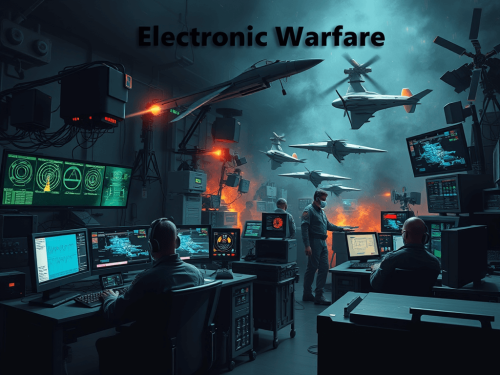
PCBs are crucial in electronic warfare, assisting in the detection and neutralization of enemy signals and electronic threats. They facilitate advanced jamming and countermeasure technologies.
Electronic warfare depends on these sophisticated PCBs to disrupt enemy communications, disable radar systems, and intercept data signals. Such technologies offer a strategic edge by hindering adversaries from obtaining vital intelligence or carrying out accurate attacks.
Unmanned Aerial Vehicles and Drones
UAVs and drones make use of PCBs to aid in navigation, real-time data processing, and remote-control systems. By doing so, they enhance battlefield reconnaissance and surveillance capabilities.
Military drones with advanced PCBs can autonomously accomplish missions, conduct precision strikes, and go for real-time intelligence gathering. These drones have reconnaissance, search-and-rescue, and high-risk combat missions.
Military Vehicles and Weapon Control Systems
Military & Defense PCBs, as part of vital control and monitoring equipment, have developed from armoured vehicles to automated weaponry. These ensure the efficiency of operation and advantage during the battle.
Military vehicles with advanced PCBs allow GPS navigation and real-time communication, threat detection, and automated weapon systems. All these technologies improve battlefield safety, precision targeting, and overall mission success.

Naval Defense Systems
Deep-sea operations and anti-submarine warfare employ military PCBs onboard naval ships and submarines that are used in sonar, navigation, and missile defense systems.
Such boards belong to a class of highly resilient military PCBs in naval vessels' citadels. They support advanced defense mechanisms like torpedo detection, long-range missile systems, and electronic navigation. Seamless communication and accurate targeting during a naval battle scenario are ensured through the prevention of isolation of high-performance components.
PCB Design Considerations for Military Applications
High-performance laminates and metal-core PCBs are carefully chosen to enhance resilience and maintain signal integrity. Environmental protection is achieved through potting and conformal coating techniques. It is essential that all components undergo thorough validation and testing to ensure compliance with MIL standards for PCB design, such as MIL-PRF-31032 and IPC-6012 Class 3A standards.
Additionally, military PCBs are designed with redundant circuitry to prevent total system failure in the event of damage. They also incorporate advanced power management systems to function effectively under varying electrical loads.

Advanced PCB Technologies in Military Applications
- Embedded components minimize size yet provide enhanced functions.
- HDI-PCBs are an advantage in terms of miniaturization and performance enhancement.
- Rigid-flexible PCBs have actually been an asset with respect to the durability and flexibility of dynamic military systems.
- AI-integrated PCB can smartly and autonomously decide for military systems. By integrating ML and real-time online data analysis, it assists in mission planning and execution.
Conclusion
The military and defense PCBs form the backbone of modern defense technology. They provide basic systems for security and strategic advantage. They are central in modern military application spheres like radar, communication, missile guidance, and electronic warfare.
The military PCB will further develop with technological advancements, integrating AI, nanotechnology, and quantum computing to improve defense capability. FC PCBA, a top military PCB manufacturer in China, has new technologies that will certainly enhance national security and increase operational effectiveness in the military. If you require expert consultation in military-grade PCBs or military PCB assembly, please contact FCPCBA today to discuss the best-suited solutions for your defense applications.
Frequently Asked Questions
Q1. How do military PCBs stand out from general-purpose PCBs?
Military PCBs are designed and developed for high performance, extreme durability, and environmentally ruggedness. Unlike the general PCB, they follow strict military standards and offer enhanced results for defense applications.
Q2. Which is the root material of military-grade PCBs?
They are made of high-temperature laminates and advanced composites that have the best lifetime principles.
Q3. Is a military PCB given a designation for special certification?
Yes; such PCBs need to conform to quite rigorous standards such as MIL-PRF-31032 and IPC-6012 Class 3A.
Q4. Is it possible to use military PCBs in commercial applications?
Indeed, military PCBs are made with rigorous military standards, which explains why they are quite sturdy; however, the large cost involved in using military PCBs often makes them impractical to use for many commercial applications.
Q5. How do PCBs improve military communication systems?
They provide the required high-frequency transmission, electromagnetic shielding, and durability for secure and uninterrupted communication